
Custody Housing Allowance and Furniture Allowance under the Jordanian Personal Status Law

Claims for a custody housing allowance are among the most delicate files before the Jordanian Sharia courts, because they concern the home and stability of the child in custody at a moment when relations between the two parties are at their most strained. The Jordanian Personal Status Law No. 15 of 2019 deals with this right expressly in Article 178(b), and Article 179 then governs how it is assessed through two decisive standards: the provider's means, whether in ease or in hardship, and accrual from the date of the claim. There is a gap between what the text provides and what a court actually awards, a gap determined by the evidence and by how and when the claim is made, and only a lawyer who knows how this lawsuit is built can close it.
Nor does the dispute stop at rent alone. Many lawsuits run into a finer question: does an award of a housing allowance cover what is needed to furnish the home, or is the furniture allowance a separate claim with its own basis and its own evidence? It is precisely on this question that part of the custodian's rights is lost when the lawsuit is drafted imprecisely.
1. What Is Meant by the Custody Housing Allowance
The custody housing allowance is the amount to which the custodial mother (custodian) is entitled in order to secure suitable housing in which custody (hadana) of the child is exercised, where neither she nor the child has a suitable home in which custody can take place. Article 178(b) of the Personal Status Law provides that:
"The custodian is entitled to a housing allowance for the custody of the child, payable by the person liable for the child's maintenance, unless she or the young child has a home in which she can keep the child in her custody."
Two points follow from the text, and the lawyer builds the legal characterization of the lawsuit on them: the basis of entitlement is the absence of a home suitable for custody with the custodian or with the child, and the obligation falls on the person liable for the child's maintenance and no one else. Yet the wording of the text is itself disputed before the court. Determining what counts as "a home in which she can keep the child in her custody", and determining the moment at which an existing home ceases to be suitable for that purpose, are two questions the text alone does not settle; they are settled by the evidence and the way it is presented to the court.
2. How the Custody Housing Allowance Is Assessed
The legislature did not make the amount of the housing allowance a fixed figure, uniform for all cases; it tied its assessment to the financial capacity of the person liable for maintenance. Article 179 of the Personal Status Law provides that:
"The custodian's housing allowance is imposed according to the provider's means, in ease and in hardship, from the date of the claim."
On this basis, the court takes into account in its assessment the provider's financial situation, the circumstances surrounding the custody, the nature of the home suitable for the child, and the evidence submitted in the lawsuit. The words "from the date of the claim" carry a financial consequence that cannot be remedied later: whatever precedes the date of the judicial claim is not counted, however long the custodian bore the rent from her own money. Determining the right moment to file the claim, and how complete the evidence is at that moment, is itself a legal point that merits consultation, because filing early widens the period awarded while delay wastes it irreversibly.
In every file, the lawyer goes back to the legislative text itself, not to what is said about it. The image below shows the articles governing the custody fee and the child's housing allowance as they appear in the Personal Status Law, with Article 178, the subject of this discussion, highlighted:
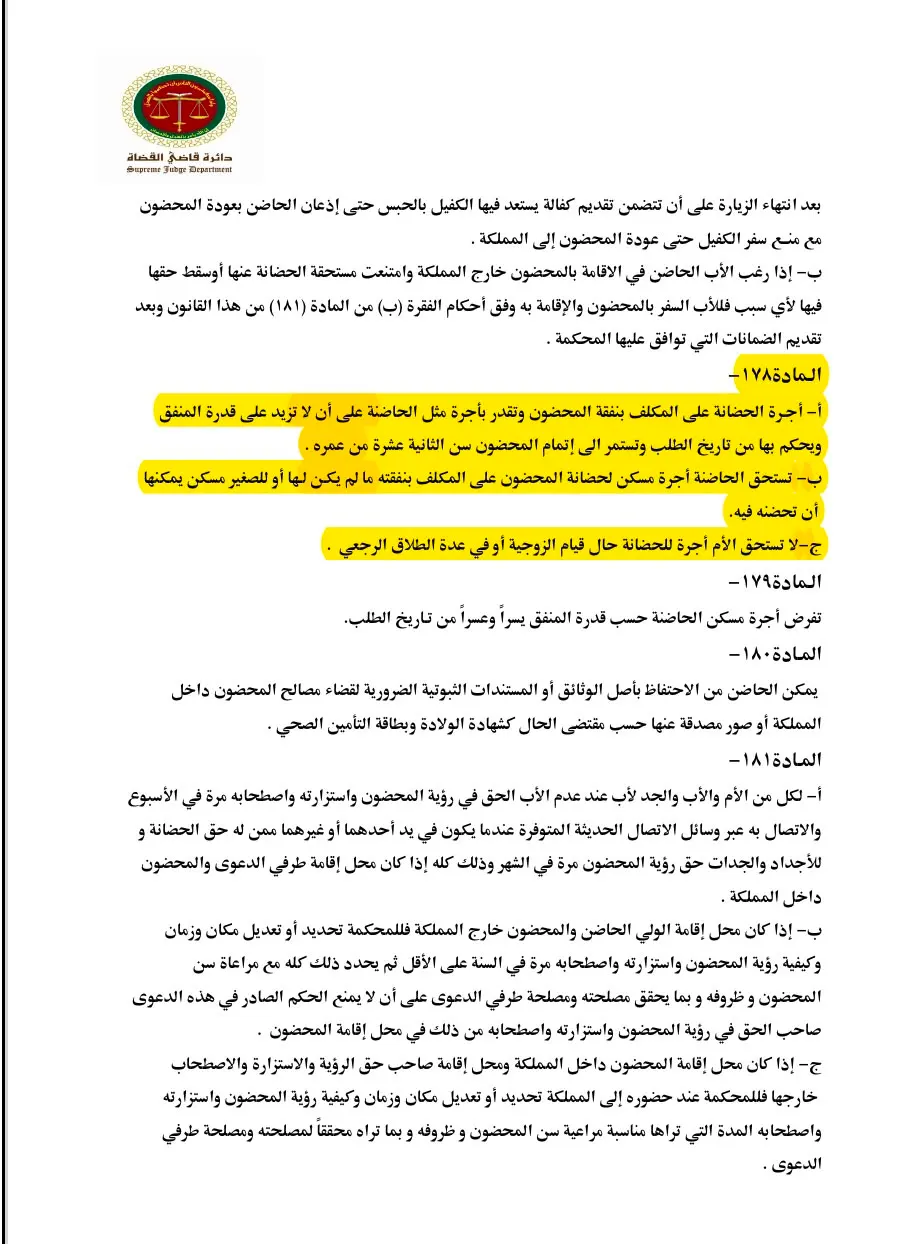
3. What the Lawyer Proves Before a Housing Allowance Is Awarded
A custody housing allowance is not awarded merely by filing a statement of claim saying that the custodian is entitled to it. Each element of entitlement is in practice a separate point of dispute that the opposing party contests, and the lawyer needs to support it with evidence the court accepts:
- That custody is actually exercised by the custodian. The opposing party often raises this point by claiming that the child lives with someone other than the custodian for periods of time, which shifts the burden of proving the actual custody arrangement to the claimant.
- The absence of a suitable home with the custodian. The usual defense here is that the custodian has a home, or a right to live in the family home, and that this removes the basis of entitlement altogether.
- The absence of a suitable home belonging to the child. This point is separate from the previous one, and is examined according to whether the child has property or a home in which custody could be exercised.
- The defendant's capacity as the person liable for the child's maintenance. Naming the wrong person as liable for maintenance makes the lawsuit defective on procedural grounds before its merits are even reached.
- A valid claim before the competent court, correctly drafted. This includes specifying the request, its amount and the date from which it runs, elements on which the operative part of the judgment is later built.
- Supporting each fact with acceptable legal evidence. Reciting the facts in the statement of claim is not enough; each fact must be matched by evidence the court accepts and that withstands contrary evidence.
The court retains the authority to assess whether these elements are met in light of the facts of each lawsuit, which makes the strength of the file depend on how the evidence is ordered, not on the number of requests in it.
4. Does the Housing Allowance Include a Furniture Allowance?
This is where the most common confusion among litigants arises. Articles 178(b) and 179 regulate the custodian's housing allowance in terms of the basis of entitlement and the method of assessment, but neither text contains an express, independent rule establishing a "furniture allowance" by that name. A claim for a furniture allowance must therefore be grounded in the nature of the request, the facts of the lawsuit and its evidence, and in the extent to which furnishing is treated as part of what a home suitable for custody requires.
The following table sets out the differences on which this distinction rests:
| Point of comparison | Custody housing allowance | Furniture allowance for the custody home |
|---|---|---|
| Legal basis | An express provision in Article 178(b) establishing the basis of entitlement, with Article 179 governing the assessment | No independent provision in the two articles establishes it by that name, so the claim rests on the nature of the request, the facts of the lawsuit and what the court accepts |
| What it covers | Consideration for providing a home suitable for exercising custody of the child | Consideration for what is needed to equip the custody home with the basic necessities for the child's residence |
| How it is assessed | According to the provider's means, in ease and in hardship, from the date of the claim | According to the circumstances of the lawsuit, the evidence submitted and the extent to which the need for it is proven |
| Nature of payment | A periodic obligation that recurs as long as its cause exists | Linked to providing the furnishing necessities, and not presumed to recur periodically |
| Practical point of dispute | Suitability of the existing home for custody, the amount of the allowance, and the date it starts to run | Independence of the claim from the housing allowance, its legal basis, and the sufficiency of the evidence that the home is unfurnished |
This distinction is not a theoretical luxury. Drafting the request as an automatic extension of the housing allowance exposes it to dismissal, while drafting it as a standalone claim with its own basis and evidence opens the door to examination on the merits.
5. Claiming a Furniture Allowance for the Custody Home
Depending on the circumstances of the lawsuit and what is proven in it, the custodian may request an award of an allowance to furnish the custody home, particularly where the home is unfurnished and lacks the basic necessities for the child to live there properly.
The evidence the lawyer works with in such a claim usually includes the lease agreement for the home, proof of its condition as to furnishing, witness testimony on its need for equipping, and documents relating to the standard of living and the provider's financial situation. But the value of each piece of evidence differs from file to file, and no single one is usually sufficient on its own: the lease agreement proves the fact and the amount of the tenancy but says nothing about the condition of the home; witness testimony may be met with contrary testimony stating that the home was already furnished; and the financial documents may be challenged as unrelated to the custody home or as predating the cause of the claim. The lawyer's real work here is therefore not collecting papers, but arranging them so that each supports the others and closes off the opponent's avenues of defense.
6. The Court's Authority in Assessing the Furniture Allowance
If a request for a furniture allowance is put before the court, its assessment does not follow a fixed amount; it depends on the circumstances of the lawsuit, the evidence submitted in it, and the extent to which the need for the allowance is proven.
Nor is it correct to assume that every judgment awarding a housing allowance automatically includes a furniture allowance. What counts is the operative part of the judgment, its reasoning, and the requests that were the subject of the court's decision, so a careful technical reading of the judgment is part of the lawyer's ongoing work, not something that comes only at the end.
7. The Effect of the Provider's Financial Means
The provider's financial means are a key element in assessing the custodian's housing allowance, based on Article 179, which ties the assessment to the provider's means in ease and in hardship. The court balances the child's right to suitable housing against the ability of the person liable for maintenance to meet the obligation.
This standard has two sides in the lawsuit: the custodian has an interest in showing the provider's true wealth, and the person liable for maintenance has an interest in showing his existing burdens and obligations. Both sides are presented to the court through evidence, not assertion, and weak presentation in either direction is reflected directly in the amount awarded.
Practical note: The standard of "the provider's means, in ease and in hardship" is not a figure that can be read off a table; it is an assessment that changes with the income and burdens of the person liable for maintenance and with market conditions at the time the lawsuit is heard. What was awarded in a similar case is therefore no yardstick for another, and estimating the realistic expected range in a particular file requires reading the evidence available in it, or consulting a specialist lawyer.
8. When Entitlement to the Housing Allowance Begins
The legislature set the date of entitlement to the custodian's housing allowance as the date of the claim, under Article 179. In practice this means that the right does not produce its financial effect through need alone, but through a claim before the competent court that meets its procedural requirements.
The housing allowance is usually claimed alongside other financial requests concerning the child, and the ordering and drafting of these requests affect one another, as becomes clear when they are compared with the rules on child support in Jordan, which govern the underlying obligation to maintain the child. Deciding what is requested within a single lawsuit and what is brought as a separate lawsuit is a matter the lawyer settles after reviewing the facts of the file.
9. When Entitlement to the Housing Allowance Ends
The housing allowance is tied to its cause, namely the custodian's need for a home in which to exercise custody of the child, so continued entitlement depends on its legal conditions continuing to be met. Circumstances may arise that affect this entitlement, including the availability of a suitable home for the custodian or for the child, the person liable for maintenance providing a home suitable for custody, the transfer of custody to another person, the loss of custody or the end of its cause, and a change in the circumstances on which the judgment was based.
The effect of these facts is examined before the competent court according to the circumstances of each case: the person liable for maintenance seeks to prove that the cause of entitlement has ended, the custodian seeks to prove that it remains, and both need evidence, not assertion.
10. Case Law and the Furniture Allowance
A number of figures and principles attributed to the Sharia Court of Cassation circulate on this subject without any published source that can be verified. Relying on a judicial principle that cannot be traced back to its official source weakens the statement of claim rather than strengthening it, and may expose the claim to doubts about its seriousness.
For this reason, the specialist lawyer builds a claim for a furniture allowance for the custody home on the provisions governing the housing allowance, on the nature of the request and the facts and evidence of the lawsuit, and on what can actually be verified at its source in the record of Sharia judgments. This discipline in choosing authority is not a formal detail; it is what separates a statement of claim that withstands argument from one that collapses at the first defense.
11. Frequently Asked Questions
Is the custodian entitled to a housing allowance if she has a house she lives in?
The text makes entitlement conditional on the absence of a home in which custody can be exercised, so the existence of a suitable home with the custodian or with the child removes the basis of entitlement. Whether the existing home is suitable for custody is a factual question the court settles on the evidence, and it is one of the points on which the other party's defense most often focuses.
Is the housing allowance calculated for the period before the lawsuit was filed?
Under Article 179, the allowance is imposed from the date of the claim, so any period before that date is not included in the assessment. That is why the lawyer treats the timing of the claim as a financial decision, not merely a procedural one.
Is there a provision in the Personal Status Law that expressly establishes a furniture allowance for the custody home?
Articles 178(b) and 179 regulate the housing allowance in both its basis and its assessment, and do not contain an independent rule establishing a furniture allowance by that name. This claim is therefore built on the nature of the request, the facts of the lawsuit and the evidence, which makes drafting it technical work handled by a specialist lawyer.
Does every judgment awarding a housing allowance automatically include a furniture allowance?
No. What counts is the operative part of the judgment, its reasoning and the requests that were the subject of the court's decision, and assuming that a judgment covers what was not expressly requested is one of the costliest mistakes in these lawsuits.
Who bears the obligation to pay the custody housing allowance?
Article 178(b) provides that the entitlement is payable by the person liable for the child's maintenance, so identifying that person precisely is a condition for the lawsuit to be correctly directed. This identification comes before any examination of the amount, and the lawyer reviews it before filing the statement of claim.
Can the amount of the housing allowance be reexamined after the judgment is issued?
The housing allowance is tied to its cause and to the circumstances on which it was assessed, and a change in those circumstances may open the way to reexamining its amount before the competent court. The lawyer assesses whether this is worthwhile after reviewing the judgment and any new facts.
Does a claim for the child's maintenance make a claim for the custody housing allowance unnecessary?
The custody housing allowance is a right established by the text in its own terms against the person liable for maintenance, and it is not presumed to be included in the maintenance awarded unless it was requested and decided. Separating these requests when drafting the lawsuit is a point the lawyer settles after studying the file.
Related Articles
The custody housing allowance is linked to other custody matters, and a change in them affects the basis of entitlement:
- Mother's Loss of Custody under Jordanian Law — because the end of custody removes the cause of entitlement to the housing allowance altogether.
- Transfer of Custody to the Father under Jordanian Law — to show how a change in the custodian affects the financial obligations linked to the home.
Legal Consultation
Custody housing lawsuits combine acute sensitivity on the side of the custodian, who bears the burden of securing decent housing for the child from her own resources, with a real financial weight on the side of the person liable for maintenance, who may be saddled with a periodic obligation beyond his means if his financial capacity is not properly presented to the court. In both cases, an error in characterizing the request, in its timing or in its evidence cannot be corrected later, because entitlement runs from the date of the claim and what has passed cannot be recovered. For specialist legal consultation in Sharia and personal status cases, or to read more on related topics in Spousal Maintenance under Jordanian Law and When Does Spousal Maintenance Lapse in Jordan, you can contact Alabwini Law Firm & Legal Consultancy.


