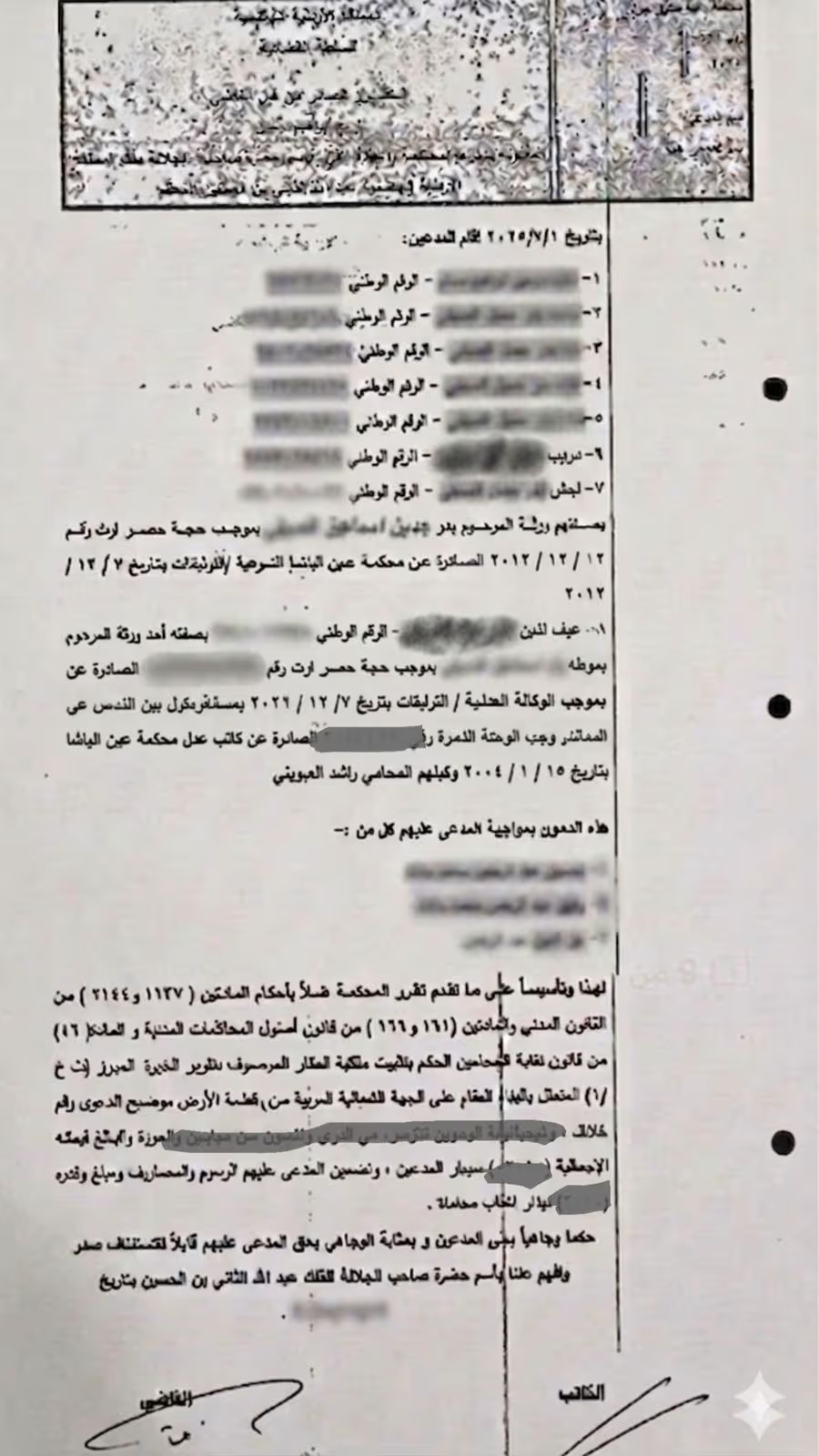
The Lawsuit to Prove Property Ownership in Jordan

Real estate disputes are among the cases with the heaviest impact on the people involved, because their subject is often a lifetime's savings or a family inheritance, and because mismanaging them can cost the owner a right that is hard to recover. The need for a lawsuit to prove property ownership arises when the owner's right is contested, when a third party objects to it, or when the owner's documents are not sufficient on their own to establish ownership before the official authorities. In Jordan this field is governed by the Jordanian Civil Code No. 43 of 1976 and its amendments, together with the registration regulations of the Department of Lands and Survey, a system in which what is officially registered is intertwined with what is established by possession or by evidence. Because the distinction between "ownership", "possession" and "registration" determines the fate of the lawsuit from the outset, the first thing the file is built on is an assessment by a lawyer specializing in real estate disputes before any step is taken.
1. What a Lawsuit to Prove Property Ownership Is and When It Is Used
A lawsuit to prove ownership is a court action in which the plaintiff seeks a judgment declaring their ownership of a particular property. It is used when there is a dispute or a denial by a third party, or when the existing documents are not enough to prove the right conclusively. It is not a formality, but a means of settling a substantive dispute over who actually owns the property.
This lawsuit relies on various means of proof to which the law gives differing degrees of evidentiary weight, so merely holding a particular paper is not in itself enough for a judgment of ownership unless it is read in the context of the other evidence and the entries of the Department of Lands.
2. Situations in Which Ownership Disputes Arise
The situations that lead a right-holder to go to court to establish ownership are many. Among the most common are a third party contesting ownership, building on co-owned land together with a claim to own the building, the loss of some official documents relating to the property, unlawful acts by others on the property, disputes between heirs or partners over a share of the property, and the need to establish ownership in preparation for a later disposal.
Assessing whether the situation calls for a lawsuit to prove ownership at all, or for another lawsuit such as partition, annulment of a disposal or correction of a register entry, is itself a legal question that comes before filing, and choosing the wrong lawsuit is often the reason it is dismissed on formal grounds, with time and fees lost.
3. Means of Proving Real Property Ownership and Their Differing Weight
Evidence of ownership is not equally strong before the court, and weighing one piece of evidence against another is among the most delicate things the lawyer studies when building the file:
| Means of proof | What it consists of | Note on evidentiary weight |
|---|---|---|
| Registered title deed (tabu) | The official ownership entry with the Department of Lands | The strongest in evidentiary weight, and can be challenged only by specific means |
| Contracts and dispositions | A sale, assignment or gift between the parties | Their weight depends on proof that they were made and are valid, and on registration where required |
| Possession (physical possession) | Actual control of the property for a certain period, subject to its conditions | A presumption assessed according to its duration, its nature and good faith |
| Witness testimony and presumptions | Witnesses and supporting documents | Supporting evidence whose weight varies with its consistency with the other evidence |
The common mistake is for the property owner to think that one piece of evidence in hand settles ownership, when what counts is the evidence as a whole, its ordering, and how well it stands up to the opponent's defenses and the entries in the land register. The weight of each piece of evidence in a particular case is a technical matter that cannot be assessed at first glance.
4. Why Property Ownership Is Not Settled by Documents Alone
Often both parties hold documents that appear valid, and the dispute turns into a battle over which evidence takes precedence, which of it prevails over the Department of Lands entry, and whether one of the dispositions is tainted by nullity or forgery. This is where the difference shows between a file managed with experience and a file left to chance.
The situation may seem simple to the owner and then reveal complications in the chain of transfer of ownership, an objection by a third party that has a basis, or an error in describing the property that exposes the lawsuit to dismissal. That is why an early reading of the file, and identifying its strengths and weaknesses before the lawsuit is filed, is what protects the owner from a hasty step that may weaken their position later.
Practical note: The entries of the Department of Lands and Survey and the court rulings on real property rights change and are updated from time to time. When assessing the file, the lawyer relies on the latest settled case law and on the actual state of the land register for the property in dispute, a point that should be settled by consulting a specialist lawyer, not by personal judgment.
5. The Competent Court and the General Course of the Lawsuit
Real property ownership disputes are usually heard before the Court of First Instance within whose territorial jurisdiction the property lies, as the body competent for real property rights. Within a general framework, the file passes through a stage of presenting evidence and defenses before the trial court, after which the judgment can be challenged at the levels of appeal within the legal time limits.
This general framework does not replace careful management of each stage: correctly identifying the parties, describing the property accurately, ordering the submission of evidence, and the deadlines for appeal are details in which an error has consequences that may be hard to remedy, and they are at the core of the lawyer's work in this type of case.
6. Common Mistakes That Weaken a Lawsuit to Prove Ownership
Among the mistakes that often cost owners their right: filing the lawsuit before a court that lacks jurisdiction, confusing proof of ownership with possession lawsuits or partition, overlooking Department of Lands entries or third-party objections, dealing with the property during the dispute in a way that complicates the situation, and delaying the lawsuit until the parties' positions change. Each of these mistakes can become a defense the opponent exploits, which is why avoiding them begins with an early legal assessment, not with a reaction after the damage is done.
7. Does Long Possession Turn into Ownership?
One question that often arises in real estate disputes is that of a person who holds a property for a long time and then claims ownership of it on the basis of that possession. The law recognizes, in certain forms, that possession may be a ground for acquiring ownership, but this is subject to precise conditions relating to the nature of the possession, its being peaceful, open and continuous, and the possessor's intent, and to a period set by the law that varies with the status of the property and whether it is registered or unregistered.
Not every possession leads to ownership: possession that is incidental or based on the owner's permission does not turn into ownership however long it lasts. Determining whether possession in a particular case meets the conditions for acquiring ownership, and which period applies to it, is among the most delicate matters the lawyer settles after examining the nature of the holding, its basis and its history, and it is an assessment that should not be built on a general impression.
Frequently Asked Questions
When is a lawsuit to prove property ownership filed?
It is filed when there is a dispute or a denial by a third party of ownership of the property, or when the existing documents are not sufficient to establish the right before the official authorities. Whether this lawsuit is the right path, or whether another lawsuit is more appropriate, is a matter the lawyer assesses according to the facts of the file before filing it.
What is the strongest means of proving property ownership?
The title deed registered with the Department of Lands (tabu) carries the strongest evidentiary weight, and can be challenged only by specific means. Even so, other evidence may prevail over it in special cases such as nullity or forgery, which makes reading the land register in light of the other evidence technical work handled by the lawyer.
Which court is competent for a lawsuit to prove ownership?
It is usually heard before the Court of First Instance within whose territorial jurisdiction the property lies. Filing the lawsuit before a court that lacks jurisdiction is one of the most common reasons for its dismissal on formal grounds, so identifying the competent body precisely is a first step in organizing the file.
Is possession (physical possession) enough to prove ownership?
Possession is a presumption of ownership assessed according to its duration, its nature, the possessor's good faith and its legal conditions, but it is not enough on its own against a registered title deed in every case. Its weight in a particular case depends on the details of the file as a whole.
Can the judgment issued in an ownership lawsuit be appealed?
Yes, the judgment can be challenged at the levels of appeal within the legal time limits if the grounds exist. Careful drafting of the grounds of appeal and observing its deadlines are matters that decide the outcome of that stage, and they are part of the lawyer's work.
Legal Consultation
Few cases depend as heavily on accurate characterization and well-ordered evidence as the lawsuit to prove property ownership. For the owner who fears losing a property that represents a lifetime's savings, and for the party asserting a right against that owner alike, documents, land register entries and possession defenses are intertwined in ways that a first glance cannot untangle. Because choosing the wrong lawsuit, the wrong court or the wrong moment can weaken even a strong position, involving a specialist lawyer early makes a real difference to the outcome. For anyone seeking a professional assessment of their real estate file, the firm offers specialist legal consultation in real estate and civil cases, informed by its work on related topics such as recovery of leased premises under Jordanian law, civil compensation under Jordanian law and the property seizure procedure under the Jordanian Enforcement Law. You can contact Alabwini Law Firm & Legal Consultancy to review the file and discuss the available options.


